> ## Documentation Index
> Fetch the complete documentation index at: https://docs.kubiya.ai/llms.txt
> Use this file to discover all available pages before exploring further.
# Agentic Engineering Minutes
> A unified metric weighting runtime, model tier, and tool usage to measure agent efficiency and cost. Track trends, analyze factors, and optimize operations across workloads and model tiers.
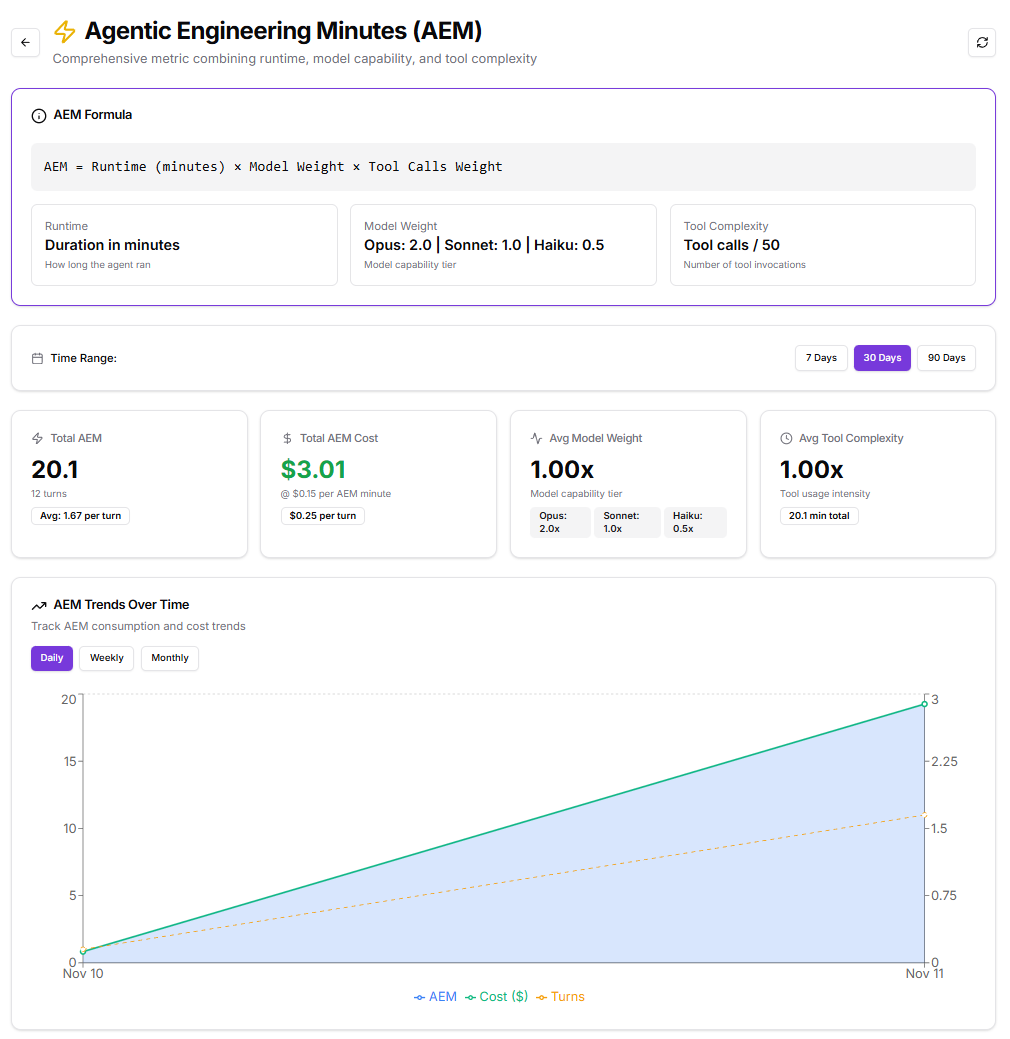 Agentic Engineering Minutes (AEM) provide a unified measure of agent efficiency, combining runtime duration, model capability, and tool complexity. This metric allows teams to assess and optimize the computational and operational cost of executing agentic tasks across various model tiers and workloads. AEM standardizes consumption data to reflect both time and resource intensity, offering a clear indicator of performance and cost-effectiveness.
## **Formula**
**AEM = Runtime (minutes) × Model Weight × Tool Calls Weight**
* **Runtime:** Represents the total execution time in minutes for an agent or workflow. Longer runtimes typically correspond to more complex or data-intensive operations.
* **Model Weight:** Reflects the computational tier of the model used.
* **Opus:** 2.0×, suitable for critical reasoning and high-complexity tasks.
* **Sonnet:** 1.0×, provides balanced performance for standard workloads.
* **Haiku:** 0.5×, optimized for lightweight or high-frequency operations.
* **Tool Complexity:** Indicates the relative intensity of tool usage. It is derived from the number of tool calls made (normalized to 50 calls). Higher complexity leads to increased AEM consumption.
This formula ensures that both model selection and tool usage directly influence the total engineering minutes attributed to any execution.
## **Key Metrics**
Over the recent analysis period:
* **Total AEM:** 20.1 minutes across 12 agent turns.
* *Average per turn:* 1.67 minutes.
* **Total AEM Cost:** **$3.01**, calculated at **$0.15 per AEM minute** or approximately **\$0.25 per turn**.
* **Average Model Weight:** 1.00×, reflecting consistent use of mid-tier (Sonnet) capability.
* **Average Tool Complexity:** 1.00×, indicating moderate tool usage across operations.
Together, these values present a balanced workload pattern, moderate runtime, single-tier model use, and steady tool invocation intensity.
## **Trend Analysis**
**AEM Trends Over Time**
This view tracks consumption and cost growth over daily, weekly, or monthly intervals. It helps identify whether performance or cost increases are linked to longer runtimes, heavier models, or increased tool usage.
Recent data shows a proportional rise in both AEM and cost, suggesting stable efficiency ratios, performance and expenditure are scaling evenly.
**AEM Weight Factors**
Trends in model weight and tool complexity are monitored together to identify shifts in workload type. For this period, both factors remained constant at approximately 1.0×, confirming steady task composition without significant variation in tool or model demands.
## **Weight and Tier Breakdown**
**AEM by Model Tier**
All activity for this interval was within the **Mid-Tier** capability band (Sonnet), accounting for **100%** of AEM consumption.
* **20.1 total AEM minutes**
* **\$3.01 cost**
* **12 turns executed**
This uniform distribution reflects consistent use of the same model type for all agentic operations.
## **Cost Optimization Insights**
Several optimization strategies can help maintain or reduce AEM consumption while preserving operational quality:
* **Use Sonnet for balanced workloads**
Sonnet (1.0× weight) offers the best equilibrium between capability and cost for most routine or analytical tasks.
* **Reserve Opus for critical reasoning**
Opus (2.0× weight) should be limited to complex reasoning, extensive code analysis, or multi-layered inference workflows to control AEM growth.
* **Optimize tool usage**
Reducing unnecessary or redundant tool invocations lowers the Tool Calls Weight component, directly decreasing total AEM.
* **Deploy Haiku for high-frequency simple tasks**
Haiku (0.5× weight) delivers significant cost savings for repetitive or lightweight operations, making it ideal for scale scenarios.
Agentic Engineering Minutes (AEM) provide a unified measure of agent efficiency, combining runtime duration, model capability, and tool complexity. This metric allows teams to assess and optimize the computational and operational cost of executing agentic tasks across various model tiers and workloads. AEM standardizes consumption data to reflect both time and resource intensity, offering a clear indicator of performance and cost-effectiveness.
## **Formula**
**AEM = Runtime (minutes) × Model Weight × Tool Calls Weight**
* **Runtime:** Represents the total execution time in minutes for an agent or workflow. Longer runtimes typically correspond to more complex or data-intensive operations.
* **Model Weight:** Reflects the computational tier of the model used.
* **Opus:** 2.0×, suitable for critical reasoning and high-complexity tasks.
* **Sonnet:** 1.0×, provides balanced performance for standard workloads.
* **Haiku:** 0.5×, optimized for lightweight or high-frequency operations.
* **Tool Complexity:** Indicates the relative intensity of tool usage. It is derived from the number of tool calls made (normalized to 50 calls). Higher complexity leads to increased AEM consumption.
This formula ensures that both model selection and tool usage directly influence the total engineering minutes attributed to any execution.
## **Key Metrics**
Over the recent analysis period:
* **Total AEM:** 20.1 minutes across 12 agent turns.
* *Average per turn:* 1.67 minutes.
* **Total AEM Cost:** **$3.01**, calculated at **$0.15 per AEM minute** or approximately **\$0.25 per turn**.
* **Average Model Weight:** 1.00×, reflecting consistent use of mid-tier (Sonnet) capability.
* **Average Tool Complexity:** 1.00×, indicating moderate tool usage across operations.
Together, these values present a balanced workload pattern, moderate runtime, single-tier model use, and steady tool invocation intensity.
## **Trend Analysis**
**AEM Trends Over Time**
This view tracks consumption and cost growth over daily, weekly, or monthly intervals. It helps identify whether performance or cost increases are linked to longer runtimes, heavier models, or increased tool usage.
Recent data shows a proportional rise in both AEM and cost, suggesting stable efficiency ratios, performance and expenditure are scaling evenly.
**AEM Weight Factors**
Trends in model weight and tool complexity are monitored together to identify shifts in workload type. For this period, both factors remained constant at approximately 1.0×, confirming steady task composition without significant variation in tool or model demands.
## **Weight and Tier Breakdown**
**AEM by Model Tier**
All activity for this interval was within the **Mid-Tier** capability band (Sonnet), accounting for **100%** of AEM consumption.
* **20.1 total AEM minutes**
* **\$3.01 cost**
* **12 turns executed**
This uniform distribution reflects consistent use of the same model type for all agentic operations.
## **Cost Optimization Insights**
Several optimization strategies can help maintain or reduce AEM consumption while preserving operational quality:
* **Use Sonnet for balanced workloads**
Sonnet (1.0× weight) offers the best equilibrium between capability and cost for most routine or analytical tasks.
* **Reserve Opus for critical reasoning**
Opus (2.0× weight) should be limited to complex reasoning, extensive code analysis, or multi-layered inference workflows to control AEM growth.
* **Optimize tool usage**
Reducing unnecessary or redundant tool invocations lowers the Tool Calls Weight component, directly decreasing total AEM.
* **Deploy Haiku for high-frequency simple tasks**
Haiku (0.5× weight) delivers significant cost savings for repetitive or lightweight operations, making it ideal for scale scenarios.